Showing posts with label Poetry. Show all posts

Tuesday, June 12, 2007

Notes from "Writing Poetry" with Robert Hilles

Writing poetry might appear to be more about inspiration than planning but today you will learn how writing poetry requires much planning.

This workshop will focus on the three cornerstones of all writing: the beginning, middle and end. Participants will learn practical tips on the process of writing poetry from the original idea to the published poem. You will learn how to start the process, what to do once you have finished a draft and, finally, how to go about marketing yourself and your poems by setting goals, setting up writing exercises, revision techniques and publication strategies.

BEGINNING
:

Set goals: Weekly, Monthly, Yearly; Career Goals (ie. Awards, Number of Books etc.); Publication Goals: Send out X poems; publish X poems in magazines; publish X poems; publish X books by certain date.

Pre-writing: Research by reading what is already out there; understand why you like the writing you like.

The first draft: Write whatever comes. Don’t censor yourself. Leave the draft for at least 30 days.

MIDDLE:

Revising/The Second Draft: Revise it once and leave for another 30 days; look at things like redundant words, bad repetitions, formal language, cut any unnecessary words (remember nothing is sacred); read it aloud see how it sounds; read it to others see how they respond.

END:

Revise your poem again and send out to magazines/organizations:
  • When considering magazines: use poetry markets for Canadians.
  • Markets include: Canadian Literary Magazines (Grain, Event, Malahat Review, Prairie Fire, Fiddlehead Review, Portal).
  • American and British Magazines.
  • Online Magazines (Ezines).
  • Poetry Websites: like Poetry Webring.
  • Your own blog (don’t under estimate this).
  • Poetry readings, contests and awards (the Writer’s Trust has the RBC Bronwen Wallace Award for Emerging Writers!).
Accept the fact you will get rejections so continue to send out until your poem is published!

Compiling a book: Once you have at least 10 poems published you can start thinking of compiling a book. Keep all your poems in a single file and name the that file the name of your book.

You need between 60-100 pages of poems to work from. Cut that down to about 70 to 80 pages of your best poems.
  • Determine sections; revise the manuscript at least 3 times over a month or more.
  • Go to Poetry Markets for Canadians and Select 10 publishers. Always start at the top.
  • Select five and start with them. Those that need a Query letter prepare that and send it along with you 10 best poems.
  • The Query letter should have 3 Key paragraphs: a) An introduction: who you are and where you have been published (keep it brief); b) manuscript description (again brief); and c) a paragraph saying you would be happy to send the whole manuscript if they are interested (if you are sending the whole manuscript write the same covering letter but send the manuscript rather than just your 10 best poems).
Networking: Many poets under-estimate the importance of networking. Most important is to Join Poetry organizations: League of Canadian Poets, Writers' Union of Canada, Canadian Authors Association, Canadian Poetry Association.

Other Networking activities include: going to readings, workshops, contacting poets you admire (via email), blogging.

--

ROBERT HILLES
won the Governor General’s Award for Poetry for Cantos From A Small Room. He has published thirteen books of poetry and five books of prose. His other books include: Finding The Lights On, Near Morning, Nothing Vanishes, Kissing The Smoke, Breathing Distance, Somewhere Between Obstacles and Pleasure, Higher Ground, and Calling the Wild.

Wrapped Within Again, New and Selected Poems won the Stephan G. Stephansson Award for best book of poetry. His second novel, A Gradual Ruin, was published by Doubleday Canada in 2004 and now is in paperback. His books have also been shortlisted for The Milton Acorn People’s Poetry Prize, The W.O. Mitchell/City of Calgary Prize, The Stephan Stephansson Award, and The Howard O’Hagan Award. His latest book of poetry, Slow Ascent, was published in the fall of 2006.

Thursday, November 09, 2006

Notes On: Ekphrasis

John Keats' "Ode to a Grecian Urn" is a great example of ekphrasis, illustrating the poet's encounter with an engraved urn that leaves him struck by the struggle to accurately represent life:

Bold Lover, never, never canst thou kiss
Though winning near the goal - yet, do not grieve;
She cannot fade, though thou hast not thy bliss,
For ever wilt thou love, and she be fair!

What is Ekphrasis?
Ekphrasis is considered a rhetorical device in which one art tries to relate to another art by defining and describing the essence and form of that original art, and in doing so, "speak to you" through its illuminative liveliness. A descriptive work of prose or one of poetry, a film, or even a photograph may thus highlight through its rhetorical vividness what is happening, or what is shown in, say, any of the visual arts, and in doing so, may enhance the original art and so take on a life of its own through its brilliant description. And as art is often the subject, if not the inspiration, for many poems, or works of prose it presents a great challenge: how does one verbalize the visual? How does one capture the emotion, energy and spirit of a piece of art with a pen?

Ekphrasis can include description of the art, or it can include enactment of the encounter in art. Sometimes it includes analysis, not only of what is seen, but of how and why such a subject is particular to the writer's existence.

Attempt an Ekphrasis
  • Choose a painting or a sculpture that interests you. (Sometimes, something you know too well isn't the best choice because there is less opportunity for discovery.)
  • Choose a voice for the person within the painting. (If the painting is an abstract or a still life, you may write as an object or as the paint itself.)
  • Write as the painter.
  • Write as you, the poet, perceiving the art.
Which voice do you like best? Which voice gained the most knowledge, and which voice wonders the most (and do you prefer knowing to wondering)? Is there a subject emerging, one you didn't know about when you began? Determine if all three sections work together, or choose the one(s) that you think are promising, and revise the work to your vision.

Ekphrasis-Related Links:
Ekphrais-poiema (Blog with examples)
Quintile Ekphrasis workshop (online Yahoo Group)

Recommended Reading:
Aristotle's On Rhetoric

Saturday, October 21, 2006

Notes On: Line Breaks in Poetry

Line-breaks and stanza-breaks in poetry are not dissimilar from punctuation: use them well, and they'll enhance the clarity of your writing, but get them wrong. and: well? you;ll be in all kinds of trouble! then(myfriend).

There is no single right place for breaking lines, or any single rule for doing so, but it's worth remembering that poetry is an oral form at heart. There was poetry before there was ever a page. Lines and stanzas are a guide to how your poem should be recited - where the sense should be emphasized, where the orator should pause in the telling. Read your poem aloud to yourself, and you'll hear clearly where the breaks should go and where they should not.

Even if you decide to attempt a traditional form (ie. a sonnet) the lines must fit the sense, not the sense the lines (which is why a sonnet is a difficult thing to get right). The variety of line length in poetry is a tool. Use it with care and you'll be on your way to creating beautiful things. Use it thoughtlessly and you'll be running with scissors through all your poor shredded efforts.

Friday, October 20, 2006

Notes from "Interactive Poetry" with Rob McLennan

On October 20, 2006 poet and editor Rob McLennan held an intimate and interactive poetry workshop at the Hazeldean Branch of the Ottawa Public Library.

Participants engaged in writing exercises and were given one-on-one evaluations of their poetry. Rob emphasized the need for poets to
find their own language and to not rely on the all-too-familiar clichés. Similarly, Rob urged poets to employ the "less is more" concept by eliminating any unnecessary poet-speak disguised as language or emotion.

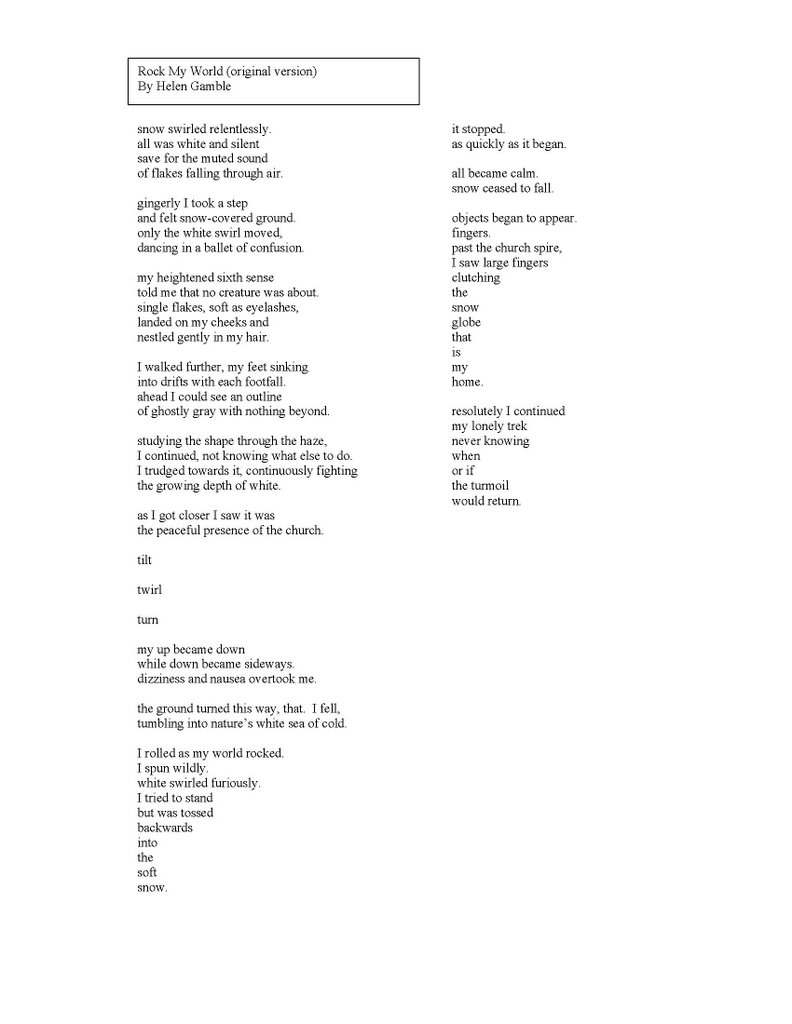
In an effort to show (not tell!) the impact of these insights, one participant, Helen Gamble (a member of the Ottawa branch of the Canadian Author
s' Association) agreed to provide us with the evolution of her poem, "Rock My World" (see below).

Upon returning home from the workshop, Helen reviewed the notes and suggestions made by Rob and the other workshop participants and set upon rewriting her poem to better convey its atmosphere. As Helen explained,
"the original version of the poem was one I struggled with for some time...I couldn'’t see that it was far too wordy and gave away too much."


The revised version of the poem - though it has been considerably pared down - proves far more evocative achieved by Helen's use of a short, staccato-like language that mirrors the disorder felt by the poem's subject.