Showing posts with label Writing Techniques. Show all posts

Saturday, October 20, 2007

Character Development Exercises by Kathy Page

What makes an engaging or compelling character?

How do you create one?

What can you do to make the people in your head come over on the page?

The two main purposes for these development exercises are 1) to help you solidify your characterization by imaging your character in a variety of situations; and 2) to you work with the information you have. Knowing your character as you do, you have to write about him or her in a way which makes use of the knowledge you have. The image often used here is an iceberg: most of what you know about your character will never be seen (or, stated) directly. Much of it will never be used at all. However, it is good for you - the writer - to know everything so that you can be confident about your character and how he or she will react in any given situation.

1st development exercise: writing in the third person, describe your character is an environment familiar to him/her, carrying out some habitual action (work, eating, sleeping, domestic chores, driving, shaving,), whilst in the grip of some intense emotion. Suggest as much as you can about your character without spelling things out or ‘telling’. Convey the mood, without naming it. Aim for about a page.

2nd development exercise: list the contents of your character's purse, pockets, grocery cart, brief case or car. Then write a short scene in which someone other than your character is looking for something in the purse, car or whatever.

Character questionnaire:

Name and age?

Nickname? Who gave it?

What is most noticeable about your character’s appearance/physical presence? How does he or she feel about it?

Describe his or her voice, verbal ticks, pet phrases etc.

Describe a gesture your character makes.

Where does he or she now live? Describe the city, town or village, the house itself. Be very specific. It doesn’t have to be in Canada. Any feelings about this place?

Has s/he lived elsewhere? What does s/he remember of these places?

What part of her home is her favourite? Least favourite? Why. Describe, using specific details.

What does your character’s bedroom/sleeping place look like? (lots of detail please)

What does he or she wear to sleep in?

What does your character dream of at night?

Who are/were her parents? Rest of family? What does she feel for them?

Class, ethnic group, religious background?

Who does s/he love, or has s/he loved? Or what. Detail.

Who loves him or her?

Married/ in relationship/single? Give names and specifics.

How does your character feel about sex/intimacy? What sexual relationship(s) is he or she involved in?

Exactly what does your character do to make a living (or in the case of a child, what do his/ her parents do; or in the case of independent wealth, how does he or she pass the time?)? How much does s/he earn? Feelings about work? What is the best part of the job, the worst?

Who or what does/he fear?

What about his or her life would he or she change if s/he could?

Does the character have a hobby? Secret passion? (Can be something ordinary like soccer playing or yoga classes or mountain biking or sewing or fixing up old trucks - or an unusual interest like some Greek poet from the third century, or collecting spiders, or walking the tightrope…

What would be his or her favourite smell ( why)?

What kind of shoes does he or she wear, (e.g. furry slippers or gumboot or trainers… new or old, style, what colour, fitting properly or too tight or too loose, nice and clean or old and smelly)? Describe exactly.

Favourite meal? Attitude to food?

Favourite clothes?

What is the worst thing that could happen to him or her right now?

What vehicles does your character use/own? (for example: bike, skateboard, truck, yacht, stroller, canoe, spaceship, battered pickup, etc.. please be as exact as possible). What are his/her feelings towards it/them. What kind of journeys does he or she make?

What is his or her most treasured possession?

What illnesses has he or she suffered, if any?

What’s his/her philosophy of life? For example’ You’ve got to look after Number 1’ or ‘Never say die’ or ‘Don’t ask for reasons.” What are his or her most strongly held beliefs?

What does he or she feel guilty about?

Biggest mistake ever made?

Best thing he/she ever did?

What, right now, does your character want most of all? His or her deepest desire – a glass of water, to get out of her marriage, a new pair of shoes, peace and quiet…

--

Kathy Page is the author of six novels, including The Story of My Face (short-listed for the 2002 Orange Prize) and Alphabet (finalist for the 2005 Governor General's Fiction Award). Complex characters and compelling narrative are Page's trademarks, as is suspense, both psychological and existential. She is an award-winning short fiction writer and has 20 years experience as a workshop leader. Kathy moved to Canada from the UK six years ago. She lives on Salt Spring Island and currently teaches fiction courses at Malaspina University College.

Saturday, September 15, 2007

Notes from "Grant Writing for Writers" with Michel Basilières

For both professional and emerging writers, a step-by step walk through of how to prepare your application for literature grants. I will guide you through the process, showing you how to avoid the most common mistakes, You’ll learn what jurors want to see, and what will make them reject an application on sight. We will cover all levels of Government funding (municipal, provincial and government councils) and by the end of the workshop, you will understand what happens to your application once it leaves your hands until the letters of acceptance are mailed out.


Preparing your application:

  1. read the Guidelines to make sure you’re eligible, and that you’re applying for the right program. There are a lot of different programs. If you’re in doubt, telephone the council to ask.
  2. read the form thoroughly. Familiarizing yourself with the form before you take up your pen will go a long way to making it less mysterious.
  3. fill out the form, by hand, preferably in black ink (blue or other colours will not copy or scan properly). Most councils now provide forms on their website which you can fill out on your computer.
  4. fill out every portion of the form, write legibly, and make sure you’re giving the information requested. If you think something doesn’t make sense or you don’t understand what they want, telephone them and ask.
  5. prepare your manuscript: make sure you read the guidelines to see what format they require. Usually this corresponds to standard manuscript format, but not always. Follow their guidelines, and when in doubt, telephone the council to ask. Set your manuscript aside for several days, and/or ask someone to proofread it for you.
  6. make all the required photocopies of the form, your resume, list of publications and your manuscript. The Council will not do this if you forget or neglect it.
  7. mail or deliver your application before the deadline. Avoid feeling rushed or panicked.
Things to remember about the grant process:

Know your deadlines: there are no extensions or exceptions. Even for famous people. Even if you go in person. Don’t expect them to keep the office open after working hours while you sit there and fill out the forms. They will not make photocopies for you.

Make sure you meet the eligibility requirements: if you don’t you’re wasting your own time, and the council’s, too. This looks bad now, and in the future. There’s no fudging this. You either have the required credits, or not. If you don’t, wait until you do and then apply.
Be realistic about your level of standing: if you are an emerging writer, apply in the emerging writer category. Yes, your work may be as good as anyone’s, and the grants are smaller. But if you apply in a category for which you don’t meet the requirements, you’ll be disqualified. Also, once you apply at mid-career or senior levels, you can’t go back. And the higher you go, the stiffer the competition.

Start early: waiting until the last minute means making mistakes. Make sure you’ve collected all your material early and that you’ve got enough time to do the job.

Ask questions: if you’re unsure how to interpret guidelines, telephone the council. they are always helpful and prompt. if you do this one or two weeks ahead of the deadline, you’ll get all the attention you need.

Make your support material scrupulously professional: after all, it’s your work that gets the grant. And you’re competing with the best. Don’t sabotage your chances by assuming the jurors will ignore shoddy packaging. Every jury has to struggle with eliminating candidates they really want to fund. This means they are looking for a reason to cut the list down. Poor presentation is a valid reason.

Have someone look over your completed application, even if it’s your mother: a second set of eyes often catches errors or typos that will be invisible to you. Or, at the very least, set your completed application aside for as long as you can: at least for a few days. You’ll catch some errors when you come back to it. Make sure you correct them.

Making contact: Once your application is in forget it. Live your life. Keep writing. don’t make follow-up calls. You won’t be told if they’ve received your application, if the jury has met yet, who is on the jury, whether you received a grant or not, or even when anything at all might happen. If the funding body needs to contact you for some reason, they will. If you’ve been approved for a grant, they’ll mail you the cheque.

Why does it take so long? Often the delay between the deadline and the announcement of results seems enormous. Typically, it’s between 4 and six months. This seems like a long time to wait, but if you’ve had any experience writing professionally – for magazines, book publishers, radio or television – you’ll know it’s not uncommon. Think of how long things take in other areas of your life: in school, at work (especially in large organizations or institutions), even driving through town. The simple fact is, everything takes longer than it should. And managing applications, juries and government procedures is a big job. Consider:
  • the sheer volume of submissions.
  • the administrative work. Once the deadline has passed, each submission is opened and checked: is it complete, or is a piece missing? Is the author eligible? Then, all the information must be entered into the Council’s database: your name and contact info, the project name, the amount requested, the time period covered by the grant, etc. This has to be done separately for each submission.
  • once the office work is done, the submissions have to be separated into packages, one set for each member of the jury and one set for the council archives.
  • the jury must be selected. The Program Officer maintains a database of potential jurors. Each jury must represent a variety of values. Members are recruited from different geographical locations, different cultural communities, and different artistic sensibilities. Councils are mandated by policy to create juries as diverse as our Canadian Mosaic. It’s not easy.
  • once potential jurors are selected, they are asked to participate. Often candidates have valid reasons for not accepting; timing conflicts, conflicts of interest (they may be applying for a grant in the very same competition!), or personal reasons such as family or health. When candidates refuse, they must be replaced, and the cycle starts again. Also, Councils must avoid using the same jurors time and time again.
  • the actual adjudication must be coordinated between all jury members and Council Staff. This means getting six to eight busy people in the same room at the same time. Some jurors have to travel from out of town, adding extra time to the process.
  • after the jury has made it’s decisions, there’s more administrative work to do. The minutes must be recorded, the results tabulated, the grants officially approved by the Board of Directors Then, the letters to each applicant (successful or not) must be written and signed, the cheques cut, press releases written, and web sites updated. These last must all be ready for release on the same day.
  • as all this progresses, the Council staff are juggling several competitions in different areas at once. One competition may just be starting as another finishes, and a third will overlap them both. Councils give money not just to individuals, but to publishers, magazines and organizations. All these go through a similarly complicated process, out of the same department.
  • and, every arts council is understaffed. The miracle is how good a record all the councils have of getting their work done on time.
What if you don't receive a grant? Don’t call to complain. Council staff cannot help you. Bothering the council staff with your anger will only make you look bad, and it won’t help you in the future. It won’t hurt your chances, either, because decisions are made by the juries, not the council staff. And there is no appeal. If you disagree with the process, take it up with your MP.

Who is the jury? Juries are composed of professional writers, editors, publishers, and others in the field. Jurors are chosen for their experience, competence and generosity. Jurors have almost always been applicants themselves, and usually have been both successful and unsuccessful. This means they understand the position of the applicants and are sympathetic. Generosity is sometimes hard to define, but essentially jurors are expected to look favourably on the process, be interested in supporting others, and be team players. No one wants a disagreeable, unfriendly person holding up the process or sabotaging anyone’s chances. The names of the jury will be kept confidential until the release of the competition results. Why? So they can make their best judgements without interference or conflict of interest. Sometimes jurors are called upon to judge the work of people they know personally. This can be awkward for everyone unless it’s done in camera. Afterwards, the names of jury members are announced in the press release, and usually available on the web site. Knowing someone personally does not necessarily put a juror in conflict of interest. Jurors are expected to (and do) declare any potential conflict. When this happens, said juror retires from the process and the remaining jurors decide on that particular application.

What do Jurors want to see?
  • Professional presentation: jurors want to see that you know how to conduct yourself and present your material. What you want to do (is it poetry, short stores, or a novel? Memoir? Essay?)
  • Who you are: jurors want to see that you’ve spent some time pursuing your career and you’ve taken opportunities. Did you study writing? Have you published, and where? How often? Fiction, poetry, or both? Plays? Screenplays? Are you responsible? Jurors want to know that if they grant you funding, you’ll follow through. This means letting them know about past projects, even ones not directly related to writing. For instance, do you have a degree? Have you ever been in charge of a project that was completed and delivered?
  • Your work. Jurors want to see that you can write. Well, duh. But think about it. You have to make sure jurors can read your submission (this is the same as being professional). Use standard manuscript format, a normal, readable typeface and most importantly eliminate any mistakes from your manuscript. This means spelling, grammar, correct word usage (a lot of people fall down here) and typos. Make it as clean as possible. Make it better than perfect.
What do jurors hate to see? Coloured paper, odd-sized paper, unusual, hard-to read fonts, binders of any kind, staples, covers with pictures, text printed sideways on the page, your life story, your opinion of your own (or anyone else’s) work, pages without numbers and titles.

--

Michel Basilières is the author of Black Bird, which won the 2004 Books in Canada First Novel Award and was shortlisted for the Stephen Leacock Memorial Medal for Humour and the Commonwealth Writers' Prize. He has received grants from each of the Toronto, Ontario and Canada councils multiple times, and has served on juries for the Ontario Arts Council. He reviews books for the Globe & Mail and the Toronto Star, has written two dramas for CBC Radio, and is teaching writing this fall at Humber College.

Wednesday, August 15, 2007

Do's and Don'ts of Writing a Query Letter by Joan Marie Galat

Presenting ideas to help develop your own unique methods to improve your writing, Joan Marie Galat presents a "do's and don'ts" list and sample letters to help sell your manuscript and market your book.


Do:
  • use a professional, formal business letter format
  • select good quality white paper and black ink
  • choose Times New Roman or another easy-to-read commonly used font
  • address your letter to a specific editor—by name
  • spell the name correctly
  • make sure your submission is appropriate for the publishing house
  • follow the publisher’s guidelines completely
  • include a hook, mini-synopsis, and writer’s biography
  • limit your query letter to a single page
  • ensure spelling, grammar, and punctuation are absolutely perfect
  • include a self addressed stamped envelope—called a S.A.S.E.
  • leave one inch margins all around manuscript pages and double space text
  • respond quickly when an editor or agent shows interest
  • read your letter out loud to help catch errors
Do not:
  • use unusual fonts, colored paper, or other formatting tricks to stand out
  • use a tiny font to make your letter fit on one page
  • call your novel a “fiction novel” (avoid redundancy!)
  • use or discuss pseudonyms
  • query more than one piece of work per letter
  • mention previous rejections
  • state that you have never been published or that you write as a hobby
  • call yourself an amateur
  • tell the editor the manuscript needs polishing
  • ask for editing advice
  • discuss copyrights or payment
  • describe how good it is or how much work you put into it
  • try to be cute (editors do not come running out of suspense to find out what happens next)
  • tell them your friends love it
  • mention that you are unpublished
  • compare yourself to other writers
  • send an original copy of your manuscript
Sample query letters (click to enlarge image):


--

JOAN MARIE GALAT is the author of the Dot to Dot in the Sky astronomy series which offers a unique blend of storytelling and science. She has enthusiastically toured in Alberta, British Columbia, and Ontario, sharing her ability to take complex subjects and make them approachable. These experiences have inspired her passion to encourage others to develop the ability to communicate through the art of storytelling.

Tuesday, June 12, 2007

Notes from "Writing Poetry" with Robert Hilles

Writing poetry might appear to be more about inspiration than planning but today you will learn how writing poetry requires much planning.

This workshop will focus on the three cornerstones of all writing: the beginning, middle and end. Participants will learn practical tips on the process of writing poetry from the original idea to the published poem. You will learn how to start the process, what to do once you have finished a draft and, finally, how to go about marketing yourself and your poems by setting goals, setting up writing exercises, revision techniques and publication strategies.

BEGINNING
:

Set goals: Weekly, Monthly, Yearly; Career Goals (ie. Awards, Number of Books etc.); Publication Goals: Send out X poems; publish X poems in magazines; publish X poems; publish X books by certain date.

Pre-writing: Research by reading what is already out there; understand why you like the writing you like.

The first draft: Write whatever comes. Don’t censor yourself. Leave the draft for at least 30 days.

MIDDLE:

Revising/The Second Draft: Revise it once and leave for another 30 days; look at things like redundant words, bad repetitions, formal language, cut any unnecessary words (remember nothing is sacred); read it aloud see how it sounds; read it to others see how they respond.

END:

Revise your poem again and send out to magazines/organizations:
  • When considering magazines: use poetry markets for Canadians.
  • Markets include: Canadian Literary Magazines (Grain, Event, Malahat Review, Prairie Fire, Fiddlehead Review, Portal).
  • American and British Magazines.
  • Online Magazines (Ezines).
  • Poetry Websites: like Poetry Webring.
  • Your own blog (don’t under estimate this).
  • Poetry readings, contests and awards (the Writer’s Trust has the RBC Bronwen Wallace Award for Emerging Writers!).
Accept the fact you will get rejections so continue to send out until your poem is published!

Compiling a book: Once you have at least 10 poems published you can start thinking of compiling a book. Keep all your poems in a single file and name the that file the name of your book.

You need between 60-100 pages of poems to work from. Cut that down to about 70 to 80 pages of your best poems.
  • Determine sections; revise the manuscript at least 3 times over a month or more.
  • Go to Poetry Markets for Canadians and Select 10 publishers. Always start at the top.
  • Select five and start with them. Those that need a Query letter prepare that and send it along with you 10 best poems.
  • The Query letter should have 3 Key paragraphs: a) An introduction: who you are and where you have been published (keep it brief); b) manuscript description (again brief); and c) a paragraph saying you would be happy to send the whole manuscript if they are interested (if you are sending the whole manuscript write the same covering letter but send the manuscript rather than just your 10 best poems).
Networking: Many poets under-estimate the importance of networking. Most important is to Join Poetry organizations: League of Canadian Poets, Writers' Union of Canada, Canadian Authors Association, Canadian Poetry Association.

Other Networking activities include: going to readings, workshops, contacting poets you admire (via email), blogging.

--

ROBERT HILLES
won the Governor General’s Award for Poetry for Cantos From A Small Room. He has published thirteen books of poetry and five books of prose. His other books include: Finding The Lights On, Near Morning, Nothing Vanishes, Kissing The Smoke, Breathing Distance, Somewhere Between Obstacles and Pleasure, Higher Ground, and Calling the Wild.

Wrapped Within Again, New and Selected Poems won the Stephan G. Stephansson Award for best book of poetry. His second novel, A Gradual Ruin, was published by Doubleday Canada in 2004 and now is in paperback. His books have also been shortlisted for The Milton Acorn People’s Poetry Prize, The W.O. Mitchell/City of Calgary Prize, The Stephan Stephansson Award, and The Howard O’Hagan Award. His latest book of poetry, Slow Ascent, was published in the fall of 2006.

Thursday, May 31, 2007

Notes from "Scene & Structure" with Pearl Luke

We don't often hear anyone say, I'm not going to use a subject and a verb in my sentence, nor an object or clause either - it's all too formulaic. And punctuation! That's really obvious. I'm striving originality. And yet it is common to hear emerging writers dismiss story structure for the same reason - that it is too formulaic. When their stories sag, or fall short of their expectations, they can't understand why.

Yet scene and structure have been the basic building blocks of fiction since Aristotle, and remain as important as ever. Knowing the purpose of structural parts and being able to use them effectively prevents writing problems and helps to resolve those that do arise; skillfully used, a structural framework serves the same purpose as the frame of a house - it provides the necessary form and strength that prevents all the beautiful, unique bits from falling in on themselves.

What is Structure?
  • Plot: chronological events based on cause & effect
  • Structure: the physical organization of the piece
  • Front to back, back to front, ends to middle
  • Beginning, middle, end
  • Plot points (change)
  • Chapters, sections
  • Scene/sequel (action scene/reaction scene)
  • Cause/effect
How do we create structure?
  • Scenes for real-time action/sequels for emotion, thought, back story
  • Beginning: open as close to change as possible.
  • Character’s goal creates a story question.
  • End: as soon as possible after question is answered
  • Pacing: control through scene/sequel and sound; short vowels (aa, e, ee, i, o, u) shorter sounds speed things up; long vowels A, I, O, U, Y slow things down.
--

PEARL LUKE is the author of two critically acclaimed novels: Madame Zee and Burning Ground, both published by HarperCollins Canada. Burning Ground was a Globe and Mail notable book of the year. It won the Commonwealth Prize for Best First Novel in the Canada/Caribbean region and was short-listed for the Chapter/Robertson Davies Prize, the Georges Bugnet award, and the Canadian Booksellers’ Libris award.

In 2006, Madame Zee was a book club pick for Chatelaine and Flare magazines. Pearl Luke mentors writers online for UBC’s Booming Ground program and privately from her website. She was writer-in-residence for the city of Taipei, Taiwan, and currently teaches writing for DeVry University Online. She is at work on her third novel.

Monday, January 01, 2007

5 Writing Resolutions for the New Year

1. WRITE EVERY DAY
Commit an hour, a half hour – even just 15 minutes – to writing every day. The goal is to make it a habit so try and set aside a time for writing the same time every day. To help you get started it might prove helpful to start keeping a journal. Though journaling is an art in itself, you may find yourself developing ideas for future story projects. If nothing else, maintaining a journal is a good way to ensure that you’re writing consistently.

2. DEVELOP/NURTURE YOUR WRITING VOICE
If you’re a writer just starting out one of the greatest difficulties you can face right from the onset is finding your own writing voice. To help develop this try reading the work of authors you admire to determine what makes their writing unique. Also read something you might not be regularly inclined to read. Can you see yourself writing this way? If not, why? These answers don’t necessarily matter, as long as you are aware of the voice.

For established writers, one’s writing voice is an automatic, built-in reaction to the art of writing. But that doesn’t mean it can’t be improved upon or developed further. Experiment by breaking out of your comfort zone. If you customarily write articles, try a short story. If you write for an adult audience, attempt a short piece for children. The goal isn’t to break into a new market, just an exercise for the muscles you already have.

3. A ROOM OF ONE’S OWN
If a lack of space is keeping you from writing, put this at the top of your list. Your resolution might also be to just make your writing space more conducive to your work. Clean up the clutter; surround yourself with things that inspire you. Have a space you look forward to entering.

4. READ MORE
Are there books you've always meant to read, but haven't? Do you have a pile of books you’ve been meaning to read but feel daunted by the task of choosing one? Make a plan. Browse bookstores (online or in person) and create a reading list. If you find your “to be read pile” overwhelming create a reading queue to help you sift through the mess.

To create a reading queue: alphabetize your “to be read” pile by author and then assign each book a number. When the time comes to pick your next book use a random number generator to decide. Yes, such dedicated organization might appear to fulfill the most compulsive of disorders but you might find that each new book selected for you is a surprise rather than an agonizing decision (well, maybe it's not that bad). And remember if you go buy a book or get one as a gift, it goes into the queue. Maybe you'll read it next week, maybe you'll read it in five years; the reading queue will decide.

5. BE EASIER ON YOURSELF
Focus on what you do accomplish this year, not on your failures. Writing is hard, and getting published even harder. Beating yourself up doesn't help anything. Reward yourself for having found something that you love this much, and for sticking to it.

Friday, December 15, 2006

Notes from "Creative Non-Fiction" with Charlotte Gray

Choosing the right subject


  • You must be prepared to live with them for several year. Consult a variety of primary materials (letters, diaries, journals) to get a sense of your subject and to assess your interest.
What story are you going to tell?
  • Kierkegaard said, "Life is lived forward but understood backward." Try to determine the aspect of the subject's life you are interested in writing about.
  • Always be aware that non-fiction (including history and biography) are always as much about the writers as the subject. The assumptions you carry into the creative process reflect the assumptions of your own era.


Research
  • Read everything, not just the primary material but also memoirs by the subject's friends and contemporaries; novels set in the same period and local histories etc.
  • Find archival photos and artefacts and to help you provide a more vivid - and accurate - description.
  • If you are writing about a particular location be sure to plan a site visit to ensure the accuracy of your work.
Invention Versus Imagination
  • Non-fiction must be about actual truth. An important difference between fiction and non-fiction is that in novels and plays, Chekov's dictum prevails: "If you say in the first chapter that there is a rifle hanging on the wall, in the second or third chapter it absolutely must go off. If it's not going to be fired, it shouldn't be hanging there." In fiction there are no coincidences: a chest pain is followed by a heart attack, a phone call is always meaningful. In real life, however, most chest pain is indigestion, a phone call is probably from a life insurance salesman and rifles gather dust on the wall.
  • Creative non-fiction tries to construct a narrative that emulates fiction by emphasizing connections. But in non-fiction, ignoring sheer coincidence means that the writer flirts with conspiracy theories and invention.


Recommended Reading

Mark Bostridge (ed.), Lives for Sale: Biographers' Tales
Hermione Lee, Body Parts: Essays on Life-Writing
Hermione Lee, Virgina Woolf
Michael Holroyd, Basil Street Blues
Janet Malcolm, The Journalist and the Murderer
Constance Rooke (ed.), Writing Life: Celebrated Canadian & International Authors on Writing & Life

Books by Charlotte Gray

Reluctant Genius: The Passionate Life and Inventive Mind of Alexander Graham Bell

Sisters in the Wilderness: The Lives of Susanna Moodie & Catherine Parr Trail

The Museum Called Canada: 25 Rooms of Wonder

Flint & Feather

Canada: A Portrait in Letters 1800-2000

Mrs. King: The Life & Times of Isabel Mackenzie King

Friday, December 08, 2006

Madman, Architect, Carpenter, Judge

"Whatever joy there is in the writing process can come only when the energies are flowing freely." - Dr. Betty S. Flowers, Madman, Architect, Carpenter, Judge: Roles and the Writing Process

It is often thought that the hardest part of writing is getting started. However, one might argue that the actual hardest part of writing is resisting the urge to critique (and delete) the work you've already begun and how to organize the execution of your project.

According to Dr. Betty S. Flowers, an English Professor at the University of Texas, the urge to abandon a project and the difficulty some writers experience in completing their work, is a result of "two competing energies [that] are locked horn to horn, pushing against each other." One is the energy fueled by enthusiasm or an emotional state, the second is a kind of critical energy, peering over your shoulder; a judge with authority and "the voice of your most imperious English teacher".

In 1997, Dr. Flowers introduced The Flowers Paradigm a method to help minimize the problems and maximize the efficiency and effectiveness of one's writing by breaking down the process into four steps - each one based on a character or personality that we all have within us.

Madman

The madman is an entity full of ideas, who writes crazily and perhaps rather sloppily, and gets carried away with the act of writing.

Start this process by promising your judge that you'll eventually get around to soliciting an opinion of your work but for now it is best to let your creative energy nave no restrictions by exploring your interests, emotions or questions that appeal to you. Talk on paper, page after page, don't take time to consult the judge or to correct sentences.

Architect

Once the madman has generated lots of ideas, the architect takes over by assessing the strongest ideas found in the madman's work. The architect's thinking is large (perhaps non linear), organizational and unsentimental, all in the effort of drafting the root idea of your narrative.

Carpenter

The carpenter sets out to build the draft. At this stage, the writing begins in earnest. And because you’ve planned the draft, the carpenter’s work is greatly eased: it’s more or less a matter of filling in the blanks. That may overstate how easy the carpenter’s work is. But
the process of building is greatly simplified when you have the architect’s specifications laid out in front of you.

The most important thing about the carpenter stage is to write rapidly, without editing along the way, simply filling in the details according to the architectural specs. If you edit, then the judge starts getting active - and this is just the type of interference your carpenter doesn’t need.

If you get stuck in a certain part, then move to the next section: you may have to leave a little hole here and there. You’ll notice, too, that the carpenter has some discretion - deciding how to finish off a corner, how to build the passage from one room to the next. Some architectural details, in other words, are left to the carpenter.

Judge

Once your carpenter has built a draft, the fun begins for your judge, who can start looking for ways to improve the draft. The judge will consider whether there are suitable transitions between paragraphs, whether you’ve used a consistent voice, comma splices, misplaced
modifiers and a variety of other things. The judge is a quality-control inspector.

Advantages of the Flowers Paradigm
  • It’s easy to remember.
  • It stresses the sequential nature of the writing process.
  • It dramatizes the need for rewriting and gives a sense of individual purpose to every draft.
  • It offers a way to deal with self-image problems that sometimes interfere with the writing process. That is, if you see yourself as a creator, you might be impatientwith the polishing and careful proofing that the judge can provide—and that every draft needs.

Tuesday, November 28, 2006

Notes from "The Writers' Third Eye" with Frances Itani

Frances Itani discusses five important elements to fiction writing:

1. Getting an Idea & the Writer's Third Eye


2. Asking "What If...?"


3. Point of View


4. Voice


5. Theme, Editing and Destination


Recommended Reading

Eliza Clark, Writer's Gym
Timothy Findley, Inside Memory: Pages from a Writer's Notebook
John Gardner, The Art of Fiction: Notes on Craft for Young Writers
John Gardner, On Becoming a Novelist
Jack Hodgins, A Passion for Narrative: A Guide for Writing Fiction
Rudy Wiebe, The Storymakers

Books by Frances Itani

Poached Egg on Toast
Deafening
Leaning, Leaning Over Water
A A Season of Mourning

Thursday, November 09, 2006

Notes On: Ekphrasis

John Keats' "Ode to a Grecian Urn" is a great example of ekphrasis, illustrating the poet's encounter with an engraved urn that leaves him struck by the struggle to accurately represent life:

Bold Lover, never, never canst thou kiss
Though winning near the goal - yet, do not grieve;
She cannot fade, though thou hast not thy bliss,
For ever wilt thou love, and she be fair!

What is Ekphrasis?
Ekphrasis is considered a rhetorical device in which one art tries to relate to another art by defining and describing the essence and form of that original art, and in doing so, "speak to you" through its illuminative liveliness. A descriptive work of prose or one of poetry, a film, or even a photograph may thus highlight through its rhetorical vividness what is happening, or what is shown in, say, any of the visual arts, and in doing so, may enhance the original art and so take on a life of its own through its brilliant description. And as art is often the subject, if not the inspiration, for many poems, or works of prose it presents a great challenge: how does one verbalize the visual? How does one capture the emotion, energy and spirit of a piece of art with a pen?

Ekphrasis can include description of the art, or it can include enactment of the encounter in art. Sometimes it includes analysis, not only of what is seen, but of how and why such a subject is particular to the writer's existence.

Attempt an Ekphrasis
  • Choose a painting or a sculpture that interests you. (Sometimes, something you know too well isn't the best choice because there is less opportunity for discovery.)
  • Choose a voice for the person within the painting. (If the painting is an abstract or a still life, you may write as an object or as the paint itself.)
  • Write as the painter.
  • Write as you, the poet, perceiving the art.
Which voice do you like best? Which voice gained the most knowledge, and which voice wonders the most (and do you prefer knowing to wondering)? Is there a subject emerging, one you didn't know about when you began? Determine if all three sections work together, or choose the one(s) that you think are promising, and revise the work to your vision.

Ekphrasis-Related Links:
Ekphrais-poiema (Blog with examples)
Quintile Ekphrasis workshop (online Yahoo Group)

Recommended Reading:
Aristotle's On Rhetoric

Friday, October 27, 2006

Notes from "Historical Fiction" with Janet Lunn

Making the Past Live

What makes historical fiction live? What is it about a good historical story that makes us feel we are actually present in another time and place?

All of us who want to write historical fiction have been lured into the past by one means or another. For Janet Lunn, "I’ve always said it was because I began life in an 18th-century farmhouse in Vermont where the past was so richly present. Much later, I spent most of my middle years in an early 19th century farmhouse in rural Ontario. But that was because I was already history bound."

Everyone has a different reason for believing themselves to be history bound. And we’re probably all wrong. Janet Lunn suspects "we’re like this simply because something in our nature pulls us into the past, makes us yearn to travel back in time."

It’s a powerful yearning. What we do about it, since no one has ever actually succeeded with time travel, is read history and historical fiction voraciously. Then some of us just have to take the next step and make our own trips, write our own historical stories. How we go about this is what this workshop was about.

According to Janet Lunn there is really only one kind of true historical fiction. Costume dramas or half-fact, half-fiction novels in which well-known historical personages are explored with fictional dialogue and, sometimes, fictional relationships present dishonest history. Genuine historical fiction comes from writers with stories developed from a response to an actual historical event or situation. The characters in these stories are true to that time and that place.

Beginning and Researching a Historical Novel

You find yourself irresistibly drawn to some period in history, some event or situation. Sometimes it only takes one line in a book; Janet was inspired to write a book for young people set in Upper Canada in 1815 as a result of reading this sentence in Catherine Parr Traill’s The Backwoods of Canada: "Even the Irish and Highlanders of the humblest class seem to lay aside their ancient superstitions on becoming denizens of the woods of Canada."

As Janet explains, "It’s a little like falling in love. You read something, you hear something, you see something and suddenly characters show up in your head. You feel a story coming on. You have to write it." So what do you do first?


What and Where to Research

  • Read every last history you can find about your period – and about the period that came before as it would have had a lot to do with the forming of your characters.
  • Research the painting, music and literature of the period – the popular as well as the classical: what were people humming as they went about their work? what newspapers did they read (if there were newspapers in that day)? which artists did they admire? What were their religious practices? etc.
  • Research the clothing, houses, house furnishings, landscape (note street names and positions in towns and cities). Discover the flora and fauna for both place and time of year; what was growing in what seasons? what did the plants look like, smell like? were the animals around all year long. Remember that some things that are around now where you story is set may not have been around then. (For example, European ships brought both mice and roses to North America, they weren’t here a thousand years ago).
  • If you can travel to the place where your story is set and walk where your characters would have walked, you will get a much stronger feeling for the place. ("I’ve always been much happier writing about a place where my feet have walked.") It isn’t always possible, of course, in which case you’ll have to rely on travel as well as history books.
  • Research the use of language. Watch out for anachronisms but beware of the overuse of archaic words; use them sparingly. And don’t try to duplicate faithfully every word’s pronunciation if there is an accent, it always sounds artificial. Try, instead, for the cadence of the speech. When you’re writing a story set in a country where another language is spoken, you will have a harder time. Reading translated novels from that language might help. This is also true for characters who speak English as a second language. If your story is set in pre-historical times you’re on your own. (For this, you might want to watch Quest for Fire, a film in which the linguistics expert, Anthony Burgess, created a language – and read William Golding’s The Inheritors, a novel about pre-language people in Europe.)
  • You can find calendars going quite far back (that differs from country to country). In some cases, for some years, you can find weather information.
  • Consult an online etymological dictionary. While you can’t always find just the word you want, you can usually find out which words you can’t use; it’s always wise to check.
  • You can discover how households were run in many places and times (not all, of course). You can find costume and household furnishings, household pets, almost anything you’re looking for just by checking Google.
  • The library in the town where your story is set, the provincial library and provincial archives if your story is Canadian, their equivalent in whatever country and jurisdiction your story fits, national libraries and archives.
  • Museums, great and small. Wonderful information is available in small country museums which are often also the local archives. In them you can sometimes find family as well as town histories. Family histories – and diaries – yield all sorts of information about daily life at the time of your story, information that you might never find elsewhere.
  • Every large city (and many a smaller one) has many sources of historical information: heritage buildings, small galleries, private collections etc. Check the internet because most cities welcome researchers and, therefore, post all their sources. Small towns do not have as many official historical sites but local librarians can usually steer you to people who might be of help. James Michener used to do his research by putting himself in the hands of local librarians. They loved to help and he loved the sources they found for him.
  • Radio, television and newspaper archives. Many of these are available online and many are micro-fiched in local/national archives.

Suggested Writing Exercises To Help You Get Started
  • Imagine yourself walking down the road, perhaps a town or village street in the place and time in which you’d like to set a story. What time of day is it? what do you see? what do you hear? what do you smell? how are you reacting? Take us, your readers, to this place
  • Take on the persona of the main character in the story that is beginning to take shape in your head. Quite unexpectedly, you, as this character, have just encountered someone. Create a dialogue that tells us something about both characters, gives us a bit of the plot, and lets us know where and when this is happening.
Additional E-Notes:

Janet Lunn offers advice on the difference on writing historical fiction for adults and children:


Janet Lunn discusses the importance of rewriting your work:


Recommended Reading

Marguerite De Angeli, The Door in the Wall
Peter Dickinson, The Kin
Esther Forbes, Johnny Tremaine
Kate Grenville, The Secret River
Eric Linklater, The Dark of Summer
John Masters, Bhowani Junction
Edith Simon, The Golden Hand
Mary Stolz, A Dog on Barkham Street and The Bully of Barkham Street
Rosemary Sutcliffe, The Eagle of the Ninth

Books by Janet Lunn

A Rebel's Daughter
Laura Secord: A Story of Courage
Maud's House of Dreams: the Life of Lucy Maud Montgomery
The Root Cellar
The Story of Canada

Saturday, October 21, 2006

Notes On: Line Breaks in Poetry

Line-breaks and stanza-breaks in poetry are not dissimilar from punctuation: use them well, and they'll enhance the clarity of your writing, but get them wrong. and: well? you;ll be in all kinds of trouble! then(myfriend).

There is no single right place for breaking lines, or any single rule for doing so, but it's worth remembering that poetry is an oral form at heart. There was poetry before there was ever a page. Lines and stanzas are a guide to how your poem should be recited - where the sense should be emphasized, where the orator should pause in the telling. Read your poem aloud to yourself, and you'll hear clearly where the breaks should go and where they should not.

Even if you decide to attempt a traditional form (ie. a sonnet) the lines must fit the sense, not the sense the lines (which is why a sonnet is a difficult thing to get right). The variety of line length in poetry is a tool. Use it with care and you'll be on your way to creating beautiful things. Use it thoughtlessly and you'll be running with scissors through all your poor shredded efforts.

Friday, October 20, 2006

Notes from "Interactive Poetry" with Rob McLennan

On October 20, 2006 poet and editor Rob McLennan held an intimate and interactive poetry workshop at the Hazeldean Branch of the Ottawa Public Library.

Participants engaged in writing exercises and were given one-on-one evaluations of their poetry. Rob emphasized the need for poets to
find their own language and to not rely on the all-too-familiar clichés. Similarly, Rob urged poets to employ the "less is more" concept by eliminating any unnecessary poet-speak disguised as language or emotion.

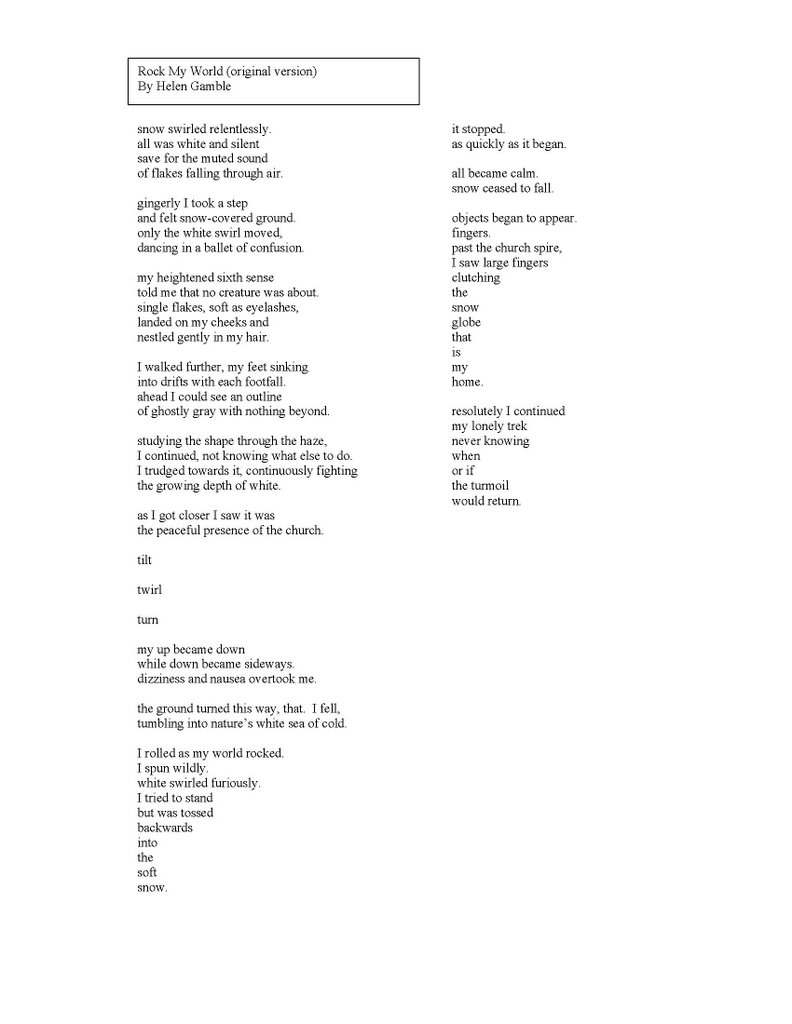
In an effort to show (not tell!) the impact of these insights, one participant, Helen Gamble (a member of the Ottawa branch of the Canadian Author
s' Association) agreed to provide us with the evolution of her poem, "Rock My World" (see below).

Upon returning home from the workshop, Helen reviewed the notes and suggestions made by Rob and the other workshop participants and set upon rewriting her poem to better convey its atmosphere. As Helen explained,
"the original version of the poem was one I struggled with for some time...I couldn'’t see that it was far too wordy and gave away too much."


The revised version of the poem - though it has been considerably pared down - proves far more evocative achieved by Helen's use of a short, staccato-like language that mirrors the disorder felt by the poem's subject.